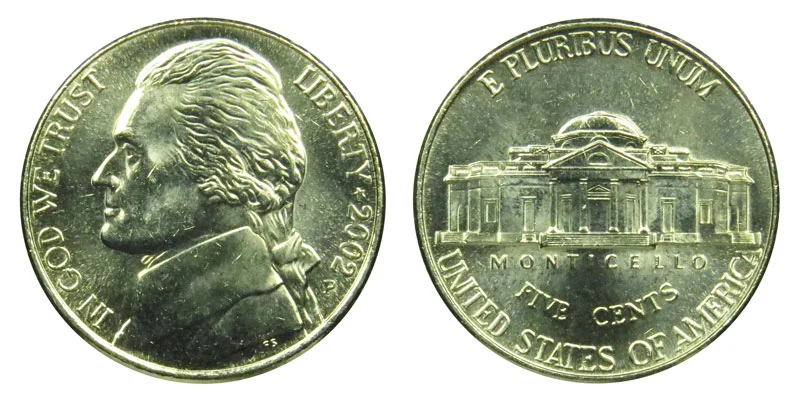
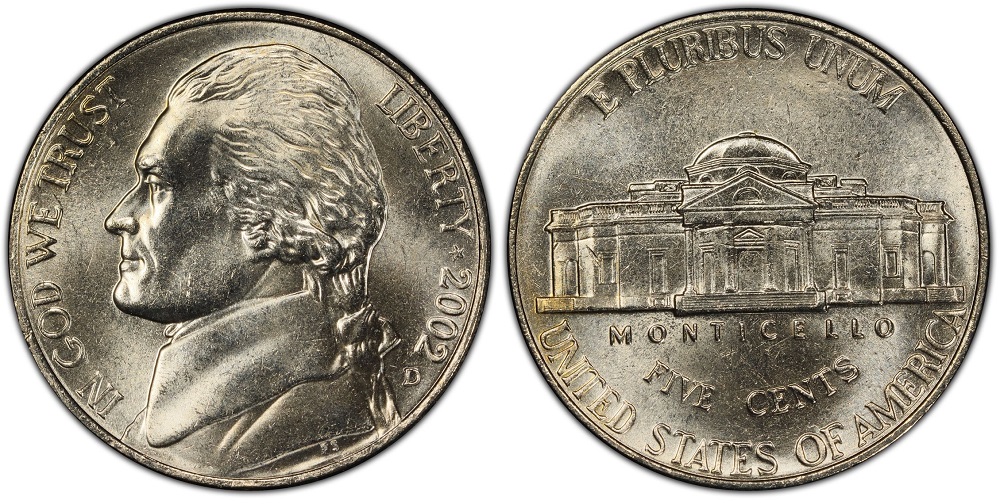
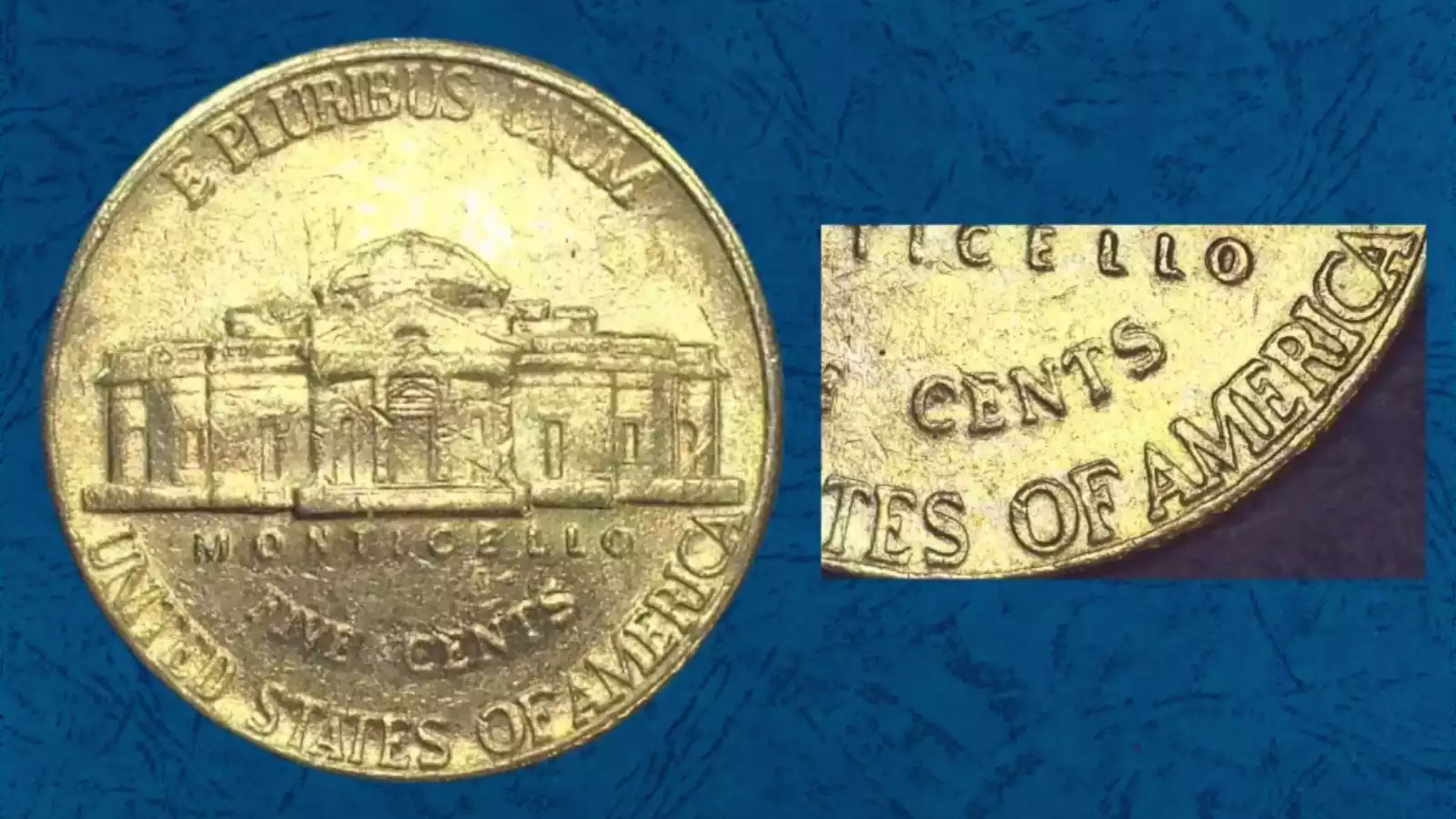
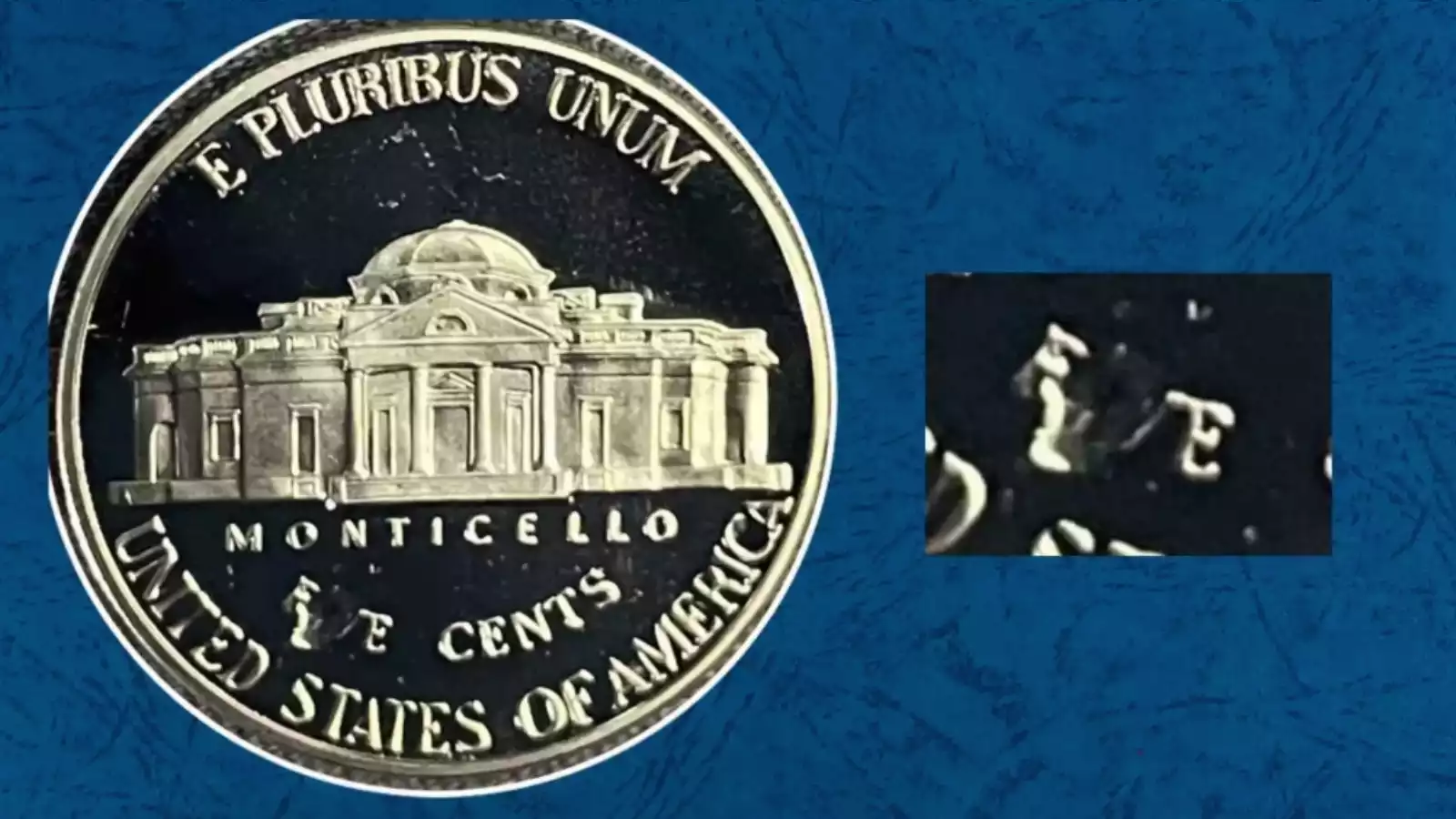
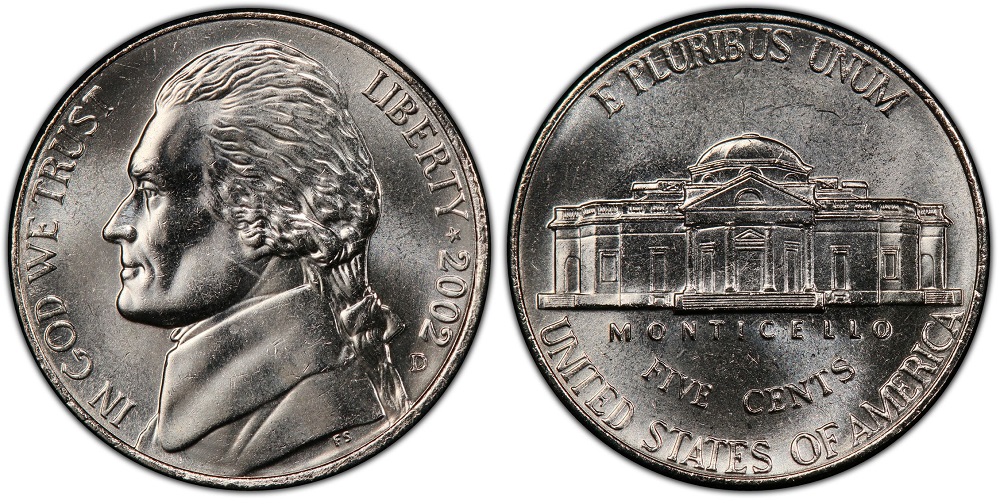
A 2002-S proof nickel in perfect PR-70 DCAM condition sold for $1,880 at Heritage Auctions in June 2013 — and a 2002-D MS-67 Full Steps specimen reached $1,187 in January 2023. Most 2002 nickels are worth face value, but the difference between an ordinary coin and a premium specimen often comes down to one thing: the Full Steps designation on Monticello's staircase.
The Full Steps (FS) designation is the single biggest value driver for business-strike 2002 nickels. A 2002-D at MS-67 FS sold for nearly $1,200; the same coin without FS topped out around $200. Use this checker to see if your coin might qualify.
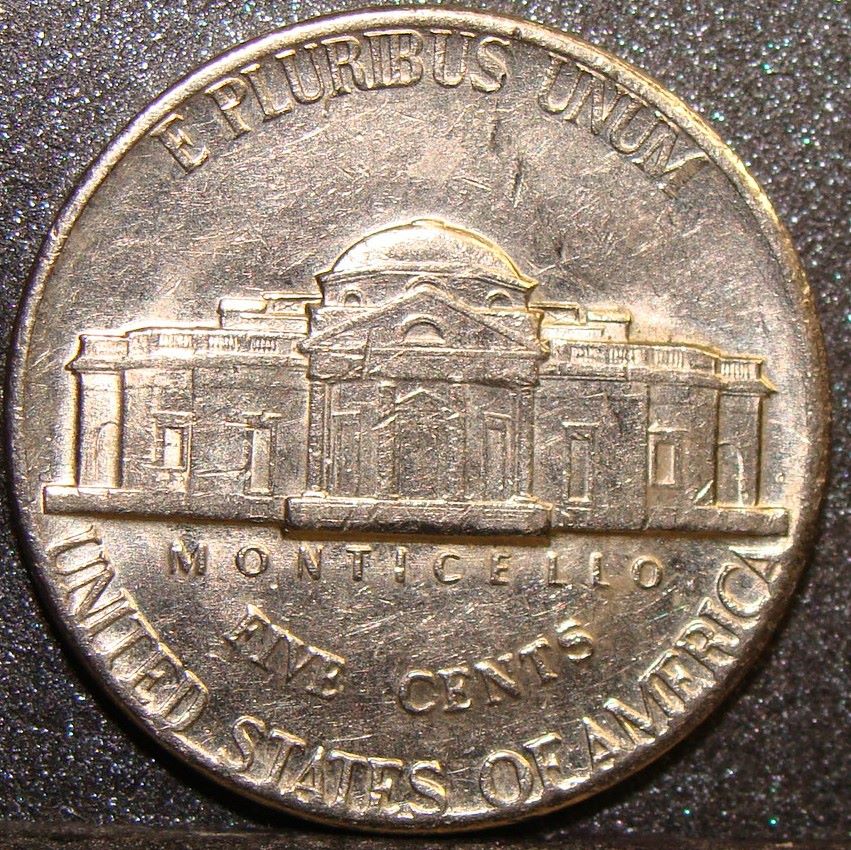
The step lines at the base of Monticello's entrance portico are weak, flat, or interrupted by contact marks. Two or more lines appear to merge together when viewed under a 10× loupe. This is how the majority of 2002 nickels grade, even in uncirculated condition. These coins trade at standard MS prices: typically $0.30–$1.25.
All five (or six) horizontal step lines run completely uninterrupted from one side of the staircase to the other, with no merging, no contact marks, and no strike weakness across that area. This is rare even on uncirculated coins and commands dramatic premiums: MS-66 FS can bring $40–$165, MS-67 FS up to $1,187 for the Denver issue.
Type what you see on your coin and our analyzer will match it against known 2002 nickel varieties, errors, and grading markers to give you a tailored value range.
Enter your mint mark, condition, and any errors in 3 quick steps to get a precise value estimate for your 2002 nickel.
Answer three quick questions to get an estimated value range for your coin. This tool covers all three 2002 mint marks and the Full Steps designation.
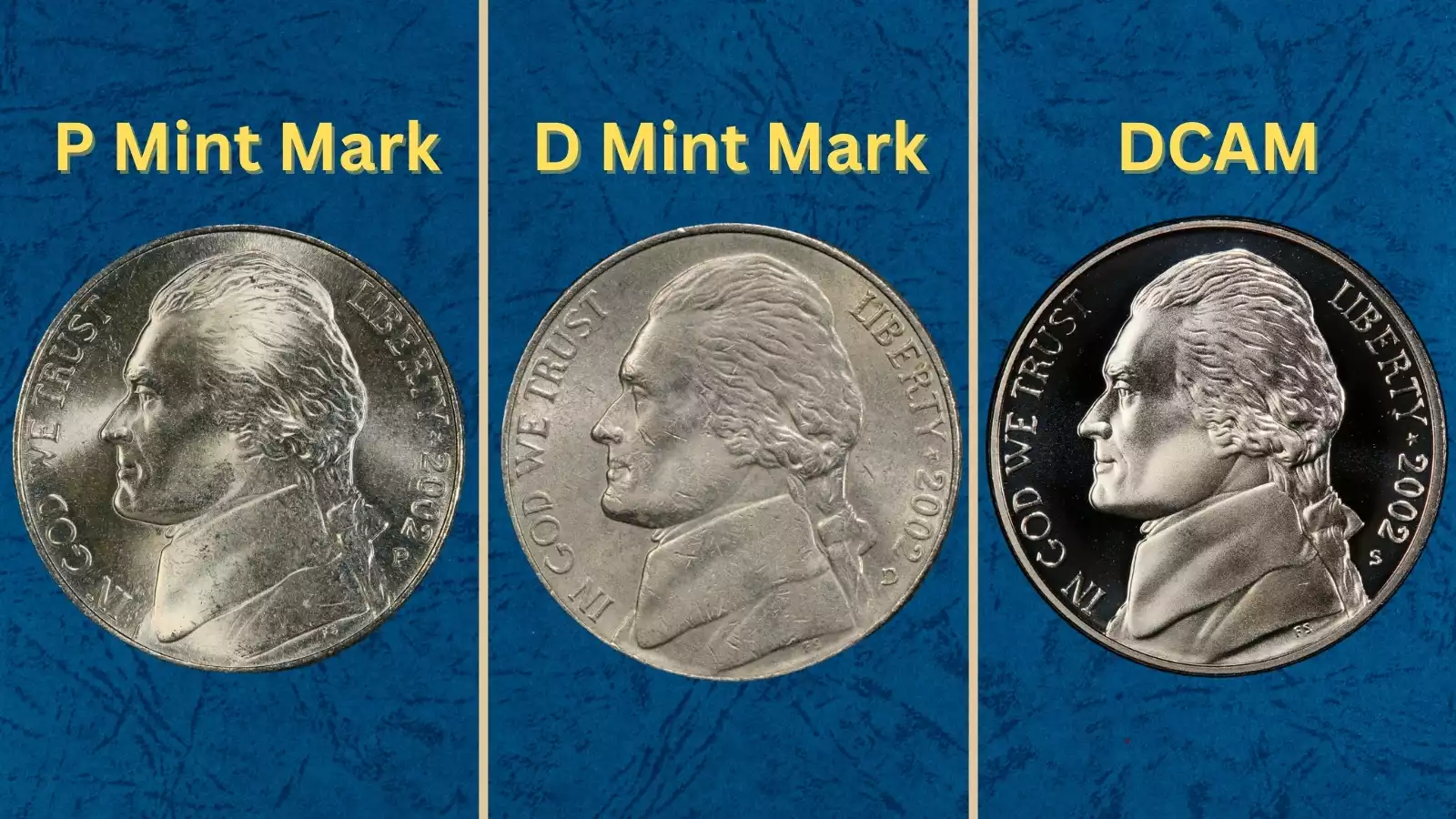
Look on the obverse (heads side), right of Jefferson's portrait, below the last digit of the date.
Worn = flat, no detail. Circulated = light wear, some detail. Uncirculated = no wear, may have bag marks. Gem = sharp strike, near-perfect surfaces.
Check all that apply. If none, leave unchecked and click Calculate.
Not sure which mint mark or condition applies to your coin? There's a 2002 Nickel Coin Value Checker online tool that lets you upload a photo and get an instant estimate without needing to know those details in advance.
Navigate directly to the topic most relevant to your coin.
Most 2002 nickels are common circulation coins worth face value, but a small number were struck with mint errors that make them genuinely collectible. An important note: in 2002 the U.S. Mint updated its production methods, meaning fewer errors escaped quality control than in earlier years — which pushes premiums higher for the genuine examples that do exist. The five varieties below represent the most documented and actively traded 2002 nickel errors, ranked by collector demand and realized prices.
A doubled die obverse occurs when the working die receives a misaligned second hubbing during the die-making process, permanently imprinting a shifted copy of the design onto the die itself. Every coin struck from that die carries the doubling. For 2002 nickels, the Philadelphia mint produced several minor DDO varieties; the most dramatic documented example sold for $1,150 at Heritage Auctions in 2023 when graded MS-66.
Look for separation and doubling most prominently on the word "LIBERTY," the inscription "IN GOD WE TRUST," and the outline of Jefferson's portrait — particularly around the cheekbone and collar. Under a 10× loupe, the doubling appears as a secondary, slightly offset ghost image of the lettering. Notch-style or hub-doubling produces wider, more separated doubling than the mechanical doubling caused by die wear, which has no collector value.
Strong DDO varieties on Jefferson nickels attract serious collector premiums because the series lacks many major obverse varieties by comparison to other denominations. Even minor doubling visible under a loupe can bring $25–$50 over the coin's base grade value. The exceptional $1,150 example demonstrates that strong, dramatic doubling in top uncirculated condition can dwarf the regular FS premium on the same date. CONECA maintains a registry of recognized 2002 nickel DDO varieties.
A cud error results from a broken or missing piece of the die at the rim. When that section of the die breaks away, metal from the planchet flows freely into the void under striking pressure, creating a raised, irregular blob of metal on the finished coin's rim or edge. The size and placement of the cud directly affects its visual drama and collectible premium. Larger cuds at more prominent positions — such as interrupting a design element — command the highest prices.
On 2002 nickels, look for any raised, amorphous lump on the rim that disrupts the normal, even border of the coin. Cuds are typically rounded and irregular, unlike the sharp, intentional raised rim of a normal coin. The affected area will show no die detail — just a smooth, elevated mass of metal. A documented 2002-D MS-69 example with a rim cud at approximately the 4 o'clock position sold for around $1,200 in 2019, attracting strong competitive bidding.
Cud errors are highly sought by error collectors because they represent a permanent, irrecoverable failure of the die — a true mint accident rather than a minor die variety. The 2002-D MS-69 cud record is exceptional; most rim cud examples from this date trade in the $200–$600 range depending on grade, cud size, and how dramatically the cud interrupts the design. Population reports from PCGS and NGC list very few certified cud errors for this specific date, underlining their scarcity.
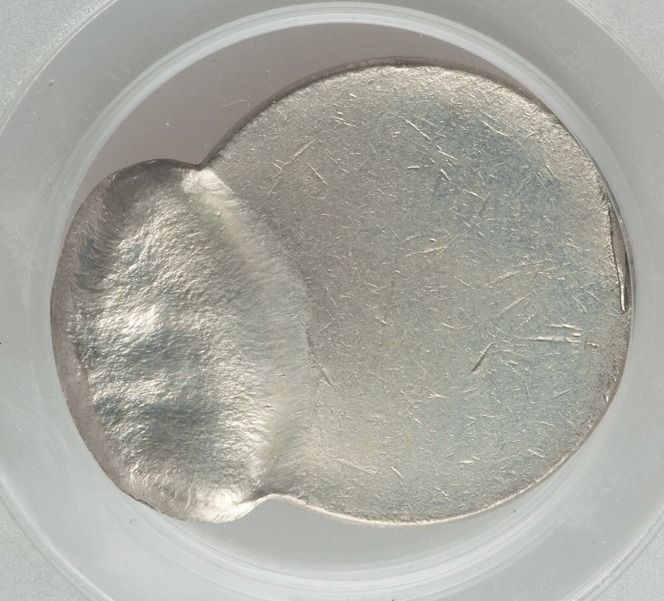
Off-center strikes occur when a planchet feeds into the coining press misaligned within the retaining collar, so the dies strike only a portion of the coin's surface. The result is a coin with the full design crammed toward one side and a blank, unstruck crescent of planchet metal visible on the opposite side. The degree of misalignment is expressed as a percentage: a 10% off-center coin has lost about 10% of its design area, while a 50% off-center coin has half the design missing.
Value depends critically on two factors: the degree of off-centering and whether the date remains fully visible. Collectors place heavy emphasis on date visibility because it confirms the coin's identity — a 2002 nickel that's 40% off-center but still shows a complete "2002" is worth significantly more than the same coin with the date partially missing. Both the Philadelphia and Denver mints released off-center 2002 nickels into circulation, and examples with 25–50% displacement while retaining a full date are the most desirable.
A 10% off-center example with a full date can bring $25–$40 in circulated condition. More dramatic specimens — 25% to 50% off-center with the full date — typically trade for $50 to well over $100 in uncirculated grades. The 2002-D MS-66 off-center strike is among the most cited examples for this date, demonstrating that collector interest in this error variety is sustained and genuine across both major mints.
Die clashes happen when the obverse and reverse dies strike each other without a planchet between them. Each die receives a partial impression of the opposing die's design, and these transferred ghost images then appear on every coin subsequently struck by those clashed dies. The clash marks show up as faint, incuse outlines of the opposing design in the field areas of the coin — so Monticello's outline might appear faintly on the obverse, or Jefferson's silhouette might ghost onto the reverse field.
To identify a die clash on a 2002 nickel, examine the fields with a 10× loupe under raking side light. Look for faint, raised lines or outlines that don't belong to the normal coin design — particularly between Jefferson's portrait and the rim on the obverse, or in the open field areas of the reverse between "FIVE CENTS" and Monticello. Strong clash marks on both sides of the coin are more dramatic and desirable than single-sided or minor clashes.
Die clashes on Jefferson nickels generate strong collector enthusiasm because the dual-sided evidence creates a visually compelling "extra" design element. A 2002-P MS-67 die clash error realized $895 in 2017, confirming that top-grade examples with clear, bold clash marks attract meaningful competitive bidding. In lower grades (MS-63 to MS-65) with strong clash visibility, examples typically trade for $50–$300 based on market comparables.
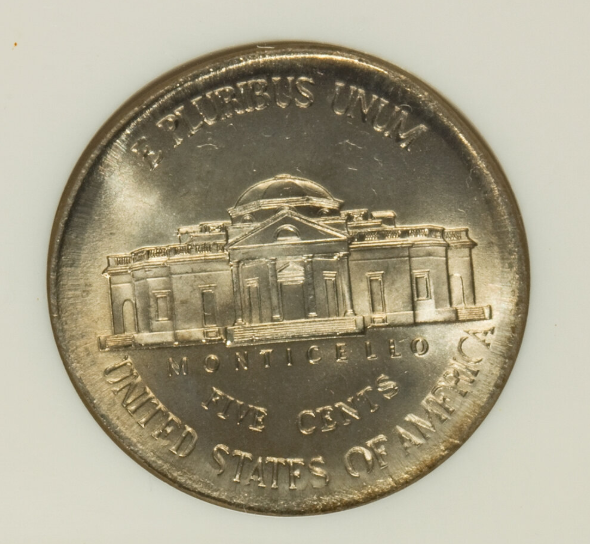
A broadstrike occurs when a planchet is struck outside the retaining collar — the cylindrical steel ring that normally constrains the coin during striking to shape its edge and maintain its diameter. Without the collar, the metal spreads outward under striking pressure, producing a coin that is visibly wider and flatter than a standard nickel. The design appears stretched or compressed near the edges, and the rim is either very thin or essentially absent.
Identifying a broadstrike on a 2002 nickel is straightforward: the coin will measure noticeably wider than the standard 21.2mm diameter and will be thinner than the standard 1.95mm thickness because the metal has spread outward. The edge, normally plain on a nickel, will appear flat and spread rather than sharply defined. Most importantly, the coin will not fit properly into a standard nickel holder or tube. Both Philadelphia and Denver produced broadstrike 2002 nickels that escaped into circulation.
Broadstrikes are among the most approachable and visually obvious error types for beginning collectors. Even in circulated grades, examples typically command $20–$30 over the coin's base value. Well-struck broadstrikes in uncirculated condition — where the design detail is still sharp even though the coin is physically spread out — are more desirable and can bring $50–$150 or more. The combination of high visual impact and relative accessibility makes this a popular entry point for error collecting.
Run it through the calculator — select your mint mark, condition, and the matching error box to get a tailored value estimate in seconds.
The table below covers all five key varieties across four condition tiers. For a thorough step-by-step 2002 nickel identification breakdown with grading photos, see this complete 2002 nickel value guide and reference. The signature Full Steps row is highlighted in gold; the rarest documented variety (Rim Cud) is highlighted in orange.
| Variety | Worn / Circ. | AU / Light Wear | Uncirculated | Gem (MS 65+) |
|---|---|---|---|---|
| 2002-P Standard | $0.05 – $0.15 | $0.60 – $0.90 | $1 – $5 | $5 – $27 |
| 2002-D Standard | $0.05 – $0.15 | $0.60 – $0.90 | $1 – $5 | $5 – $33 |
| 2002-P / D Full Steps ⭐ | N/A (FS requires Unc.) | N/A | $11 – $165 | $165 – $1,187 |
| 2002-S Proof DCAM | N/A (proof only) | N/A | $2 – $4 | $10 – $1,880 |
| Error Varieties ⚡ | $20 – $50 | $50 – $200 | $100 – $500 | $500 – $1,200+ |
⭐ Full Steps row covers both P and D issues; top end of range reflects 2002-D MS-67 FS record sale of $1,187. Proof DCAM values: raw examples $2–$4; PR-70 record $1,880. Error values are approximate ranges across all documented varieties.
📱 CoinHix lets you scan your 2002 nickel's photo on-the-go and cross-reference its grade and features against the value ranges above — a coin identifier and value app.
| Mint | Mint Mark | Mintage | Type | Notes |
|---|---|---|---|---|
| Philadelphia | P | 539,280,000 | Business Strike | Standard circulation issue; more examples known with weak steps than Denver |
| Denver | D | 691,200,000 | Business Strike | Highest circulation mintage; consistently better strike quality than P mint for this date |
| San Francisco | S | 3,211,995 | Proof Only (DCAM) | Sold in annual proof sets; Deep Cameo finish; not released into circulation |
| Total | — | 1,233,691,995 | All Types | Over 1.2 billion coins; circulation survival rate very high for common grades |
Despite the high mintage, Full Steps examples are genuinely scarce: strike quality at the Monticello staircase is highly sensitive to die polish, planchet surface quality, and striking pressure. The Denver mint's 2002 production consistently outperformed Philadelphia for step definition, explaining why the 2002-D FS auction record ($1,187 at MS-67) exceeds the comparable Philadelphia record by a wide margin.
Grading is the single most important skill for knowing what your coin is worth. For Jefferson nickels, the Monticello steps on the reverse play a role in grading that is unique among U.S. coin series.
Heavy flat wear has removed most of Jefferson's hair detail and all but the outline of Monticello. The steps are completely flat. These coins are worth face value (5¢) regardless of mint mark. Key wear points: Jefferson's cheekbone, the high points of his hair, and the triangular arch of Monticello's pediment.
Light wear is visible on the high points — Jefferson's cheekbone and the columns of Monticello — but most design detail remains sharp. Some original luster may survive in the recessed areas. These coins typically bring $0.60–$0.90. The steps on Monticello will show at least traces, but not the full, uninterrupted lines required for the FS designation.
No wear anywhere on the coin's surfaces, confirmed by unbroken mint luster under a single light. However, contact marks from bag handling are normal and acceptable at this level. The steps may or may not show full detail. These coins bring $1–$5 for standard strikes. A coin must have no wear AND have 5–6 complete step lines to qualify for the Full Steps designation.
Exceptional eye appeal, minimal contact marks, strong luster, and sharp strike across all design elements. Add the Full Steps designation and value climbs dramatically: MS-65 FS brings $11–$165, MS-66 FS commands $40–$165, and MS-67 FS has reached $1,187 for the Denver issue. Only the finest, sharpest-struck examples will qualify at this level.
🔬 CoinHix helps you match your coin's observable details against graded reference examples to estimate condition before submitting — a coin identifier and value app.
The right venue depends on your coin's value tier. High-grade FS or error coins deserve a different approach than circulated pocket change.
The top choice for MS-66 FS or higher, confirmed error coins, or any 2002 nickel worth $200+. Heritage's collector base is deep and competitive — the $1,187 MS-67 FS record and $895 die clash record were both achieved in major auction settings. Expect 12–16 week turnaround and a buyer's premium of approximately 20%.
Check recent sold prices for 2002 P Jefferson nickels and completed eBay listings to calibrate your asking price before listing. eBay works well for $20–$200 coins if you photograph the steps clearly and describe any errors accurately. Graded slabs (PCGS/NGC) sell faster and at higher prices than raw coins at this range.
Walk-in dealers offer immediate payment but typically pay 50–70% of retail value to leave room for their margin. Best for bulk lots of circulated 2002 nickels where auction overhead isn't justified. For any coin worth over $100, comparison-shop at two or three dealers before accepting an offer — prices vary considerably between shops.
The r/Coins4Sale and r/CoinSnap communities are active with knowledgeable collectors who pay fair prices for interesting coins. Good for error coins in the $25–$150 range where professional grading costs aren't justified. Post high-resolution photos of both sides plus a close-up of the Monticello steps. Transactions use PayPal Goods & Services for buyer protection.
Professional grading by PCGS or NGC costs $30–$150+ per coin at economy tiers. Only submit if your coin appears to grade MS-65 FS or better, or if you have a confirmed error. A genuine PCGS or NGC label dramatically improves marketability and realized price — especially on eBay and Heritage, where buyers pay meaningful premiums for the authentication guarantee over raw, unverified coins.
Use the free step-by-step calculator — enter your mint mark, condition, and any errors. Get an instant value estimate based on real auction data.
Check My 2002 Nickel Value Now →